
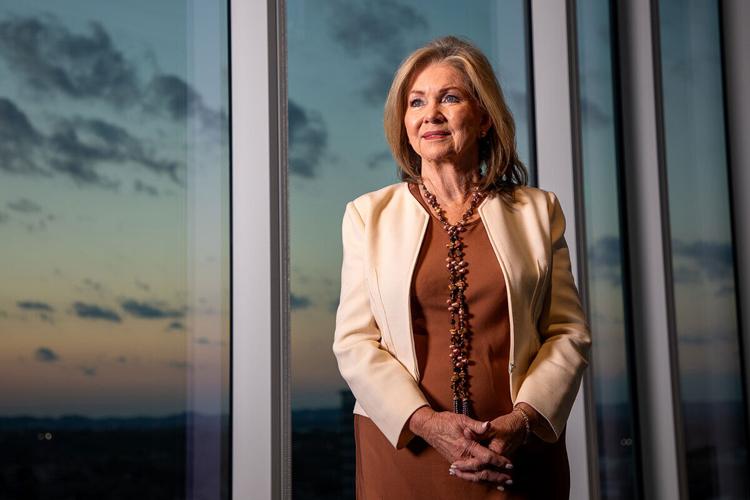
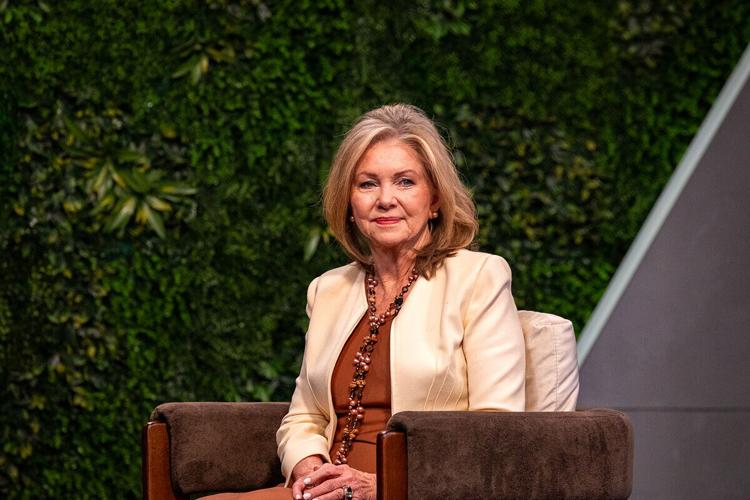


Gov.-Elect Marsha Blackburn
On Election Day, Nov. 3, 2026, Marsha Blackburn became Tennessee's first woman governor-elect and effectively became the state's most powerful woman. And so, the Post has named Blackburn as a special addition to the 2026 list of Most Powerful Women.
Over the years, Blackburn has risen in political power from a state lawmaker — called "a caucus of one" as the only Republican female state senator — to one of the nation's senior senators who has the ear of the president. Though this election was contentious and marked by a shift both nationwide and in Tennessee toward the Democratic Party, Blackburn still carried the victory in the end. And for the next four years, she will influence the future of Tennesseeans' lives beyond party politics.

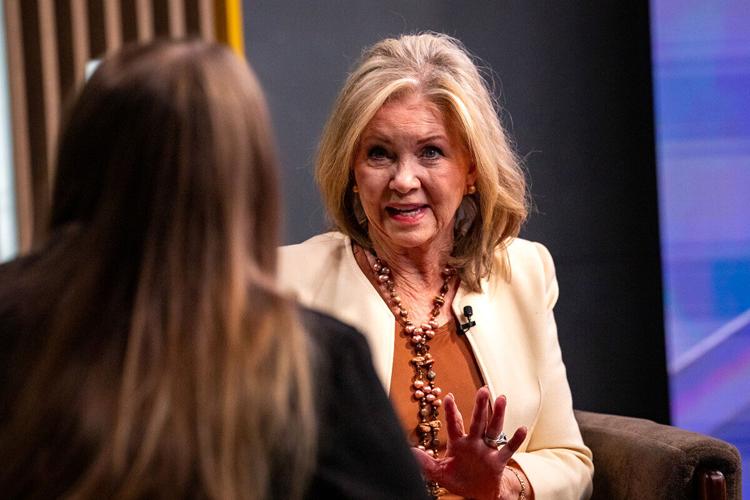
Gov.-Elect Marsha Blackburn sits down for an interview with Nashville Post Editor-in-Chief Nicolle Praino.
Answer scale
- ✓ Promise
- She said what she will do.
- ◐ Reviewing
- She said she is looking at or open to something, without committing.
- ? Needs clarity
- She answered part of the question or left details open.
- – No answer
- She did not directly address what was asked.
Each excerpt shows our question in full and her words as spoken. Notes from the Post are in gray boxes. Listen to the full episode.
State Department of Government Efficiency
Blackburn said the first step of a state DOGE is "to engage members of the General Assembly," and she's starting during her transition.
With the U.S. Department of Government Efficiency, Elon Musk was a part of that. There were other private sector folks who played a part. Do you envision there being private sector involvement in the Tennessee department?
Post noteBlackburn did not answer directly yes or no if there would be private sector involvement. Read her answer below.
Right now, I think we're going to be able to do a good bit of this algorithmically. I also think that much of it is going to be done by commissioners who share my vision for making certain that we reduce what we spend and that we are accountable to the taxpayer for every dollar. And then of course our Senate budget chair, Chairman Watson and the House Chair, Chairman Hicks are very much a part of this, as are the members of the General Assembly who are the ones who've been bringing those good ideas forward and saying, "We've got some things we want to put on the table to make happen."
Folks who have been in office previously who are part of the Republican supermajority have helped craft the budgets for the past several years. So they obviously all will already have a lot of those ideas ... How do you pick what stays and what goes? Who has the final say in this?
Post noteBlackburn said the state lawmakers who chair the budget committees would work with her cabinet members.
Well, we are going to work with the budget chairs on that. The good thing is everybody's got ideas. Everybody has had something that they've wanted to see reworked. We're talking to people that will be in the cabinet who have had interactions with different departments or the departments that they're going to, and they're saying, "Here is something that has been done and here is a way we can do that differently." Or here is how we could better use technology if we were to go to a different application and provide a better service for Tennesseeans. And that's what we want. Every dollar the state government has is a taxpayer dollar and we should be a good steward of that.
Going on towards the end of the year always budget hearings where we're already hearing from departments about what their needs are and that sort of thing. How do those hearings play a factor in this process?
Post noteAfter this interview, the Post discovered budget hearings have not been ongoing like usual because of the governorship transition. Some of the leaders of the state departments will remain, but some will be different, and the transition team is currently making their selections. The leaders of the departments will impact each department's requests to the governor for their budget priorities. It is unknown at this time if Blackburn will meet publicly with new department heads before submitting her budget to the General Assembly.
One of the things that has happened is that our team that will lead policy and legislation have certainly been paying attention to this. And as the existing commissioners have worked on their presentations for the budget hearings, they all knew that I was going to look at how we achieve greater efficiency and reduce our spending. So they've gotten a head start and they've actually come forward with some ideas that we'll be able to build on. And I think writ large, what we have to realize is Tennessee is a well-led, well-governed state. We have a firm foundation. We have a balanced budget every single year. And as we say, there are different services that people may need. It's up to us to get inside that budget to remove any of the waste that is there to root out fraud that is there and to make certain that the taxpayer is going to see that we've been able to reduce that spending, that we're able to reduce the employee count and that we are responsible to them for how the state budget's going to work.
Have any red flags been raised to you already about fraud specifically?
Post noteBlackburn didn't say that anyone has raised a specific concern about fraud in the budget but said that she wants to look at error rates of benefits. Further clarity is needed on what kinds of errors and benefits.
We are always on the lookout for fraud. And as we look at error rates when it comes to benefits, this is a space where we will do a little bit of a deeper dive to make certain that the benefits are going to people who deserve those benefits.
Infrastructure
One of the big items that legislators have publicly said they would be digging more into, especially when a new governor comes to take the seat, is transportation ... There was the Transportation and Modernization Act, but we know that doesn't go far enough for what the department itself has said it needs. How can you address that with talking about efficiency and needing to maybe direct some dollars to that department, or any department that needs it, but specifically transit?
Post noteBlackburn broadened her answer to all infrastructure needs rather than specifically transit. But she said for roads that she doesn't know what the answer will be but that her administration is going to review the options.
Well, and infrastructure, I'll broaden that question out just a little bit because infrastructure is roads, rivers, rails, runways, water, wastewater, broadband and quantum. And all of that goes into the infrastructure that is necessary to support a growing population. Well, Tennessee has some of the fastest-growing counties in the country and we have seen that population growth. We're seeing it around middle Tennessee. We've got a pocket of it over in East Tennessee. That's a good thing. And what we want to do is make certain that transportation and infrastructure, that can all keep pace with growth. Right now it's not. And you have to go back 20-something years to see where we kind of got off track with that because we've always paid for our surface transportation as we laid the asphalt and we didn't bond our roads. I don't know what the answer is going to be with that. I have been meeting with the committee chairs for the Senate and the House to look at this and to say, how do we catch up? Now, one thing we know is looking creatively, Choice Lanes, that has been passed. That is a process that we will continue to work through. There will be a series of payments that are concession payments, they're called, that will come to the state. So we will begin to monitor that and see if after we get the first choice lane project going, if we want to do others. I think that the creativity of the Boring project is something that is significant and should be looked at. We have some of our legislators who want to look at other rail projects that may be helpful. Certainly, we're open to that. And then we're going to need to look at things by different segment, if you will. We've got about 1,200 miles of interstate, U.S. interstate. Then we have our U.S. highways. Then you've got state highways and there are about 13,000 miles of state highways that are in the state. And then you have your local jurisdiction roadways. All of those, each one of those are funded by a different stream of money. So drilling down on those and beginning to look at priority projects within those different sections is I think going to help us focus on the problem and how we best meet that deliverable.
You mentioned that some are interested in rail projects. Just speaking a little bit on partisan politics, I know that a lot of times that comes from maybe some of the Democrat side, and we haven't heard that as often from Republicans, but we know that there is a Republican supermajority; you're a Republican governor. Is there any appetite for it from the Republican side for larger commuter rail or anything of the like?
Post noteBlackburn said there was an opportunity to discuss rail options, but that cost was a factor.
There's always going to be the opportunity to look at something that would help move traffic off the interstates and find those solutions to help people get where they're going. Now, short line rail, and we have a lot of short line rail in our state, and it becomes that cost. You have to do that cost analysis and the cost benefit on that to see how you're going to be able to pull that rail in then. When you get to the terminus, what kind of transportation do you have available that is going to get people to their destination and is that going to be done in a timely manner? This is another of those areas that legislators are saying, "We're open-minded to putting this on the table and talking about it. So let's discuss it." We'll see where it takes us.
Affordability
When you talk about the lives of Tennesseans, [affordability is] where everybody's mind is at right now. So what do you plan to do to address that on day one?
Post noteBlackburn said that she would consider options to lower taxes for seniors and first-time home buyers. She also mentioned removing regulation around construction to lower costs of building new homes. But, clarity is needed about further impacts for the everyday citizen.
A DOGE will make certain that we are not increasing any taxes. I will add to that there are some things that we can do when you look at property taxes. And of course we passed the no state property tax ever, which is a good signal. And now, working with the legislators on different proposals that are there, whether we do something that would be a homestead exemption or a property tax cap, we've got several proposals. Even one legislator has a proposal that would completely do away with property tax and would supplant that with a sales tax. So good discussions there. There's talk with different mayors about how we could go about capping tax for seniors and doing a property tax abatement for first-time home buyers so that young families are able to put down roots and be able to buy that home, which is something that we definitely want to incent. The other thing is looking at the affordability issue through new home construction. And as I dug down on this issue, what I realized and learned through home builders was that 27.5 percent of the cost of a new build home is actually caught up in permitting and regulation. And we're working on a federal permitting bill that would simplify. And working with TDEC, we should be able to remove some regulation to simplify some permitting and then take vacant land that the city, the county, the state owns and build workforce housing on that so that people can actually live near where they're working, your teachers, your firefighters, your first responders, law enforcement.
Affordability too comes down to the day-to-day cost of things. I know there's been a bill filed already for a grocery tax exemption ... and that's something I think that, again, back to a little bit of the partisan politics, Republicans and Democrats tend to not be able to agree on, and that's why it hasn't gotten done up to this point. How can we ensure at this point that that does happen for people, that that relief can come?
Post noteBlackburn said she was for lowering the tax burden but did not give an answer on how to make sure a grocery tax exemption is passed. She said it is up to the legislature to debate.
We're the lowest taxed state in the country when you look at the tax burden. And I hear you on the grocery tax because groceries are so expensive. And I know that Speaker Sexton has supported the move to take the tax off of milk and bread and eggs, I think it is, to zero that out. And I think the legislature is going to have a great debate on that. I'm always for lowering the tax burden. I've worked tirelessly on that and making certain we had no state income tax in Tennessee. When I went to Congress, restoring our ability to deduct the sales tax we pay every year on our federal income tax filing, removing the tax on social security that seniors were paying. And we did that for 88 percent of our seniors through a $6,000 bonus deduction, which was my legislation. They got an extra $6,000 as a deduction to their federal income tax filing. We are always looking for ways to leave more money in the hardworking taxpayer's pocket.
Education
I do want to touch on with you different education programs that have come up in the state recently, with Education Freedom Scholarships and as well as programs to advance TCAT enrollment and those sorts of things. What are your priorities? Is it the Freedom Scholarships? Is it something else?
Post noteBlackburn highlighted charter schools and briefly mentioned scholarships, broadly stating that every option should be used for children's education. She did not mention further investment in K-12 public schools. On TCATs, she said she's interested in creating student housing.
My priority is the children. We know one-size-fits-all education does not work. And Chuck and I have two children, four grandchildren. They each need different learning environments. Our children each had a different learning environment because we realize that children retain information; they absorb it differently, they retain it differently, they apply it differently. So I think getting a child into a learning environment that suits them is something that is going to be a priority. Charter schools are a priority. Public charter schools are wonderful labs of innovation. And then making certain that the ESAs and the Freedom Scholarships that we utilize every single one of those options to make certain children are in the right environment. What we should do is have as a goal to be sure every child, when they finish high school, they know how they learn, and they want to be a lifelong learner, that they're equipped for that next step, whether it's a TCAT or the military or a two-year college or a four-year college, that they have that understanding of what they want to do and how they're going to learn. So that I think is the center of this. With our TCATs, having those skills that employers say, "This is a skill set we need." When you look at emerging technology, the computational sciences, the utilization of quantum, how that fits into energy, how that fits into business, how you would use different concepts in business, in different industrial sectors, whether it's logistics or healthcare, this is something we want our children to be trained to do. And it means we need to support those classes. Of course, when you look at skilled labor, whether it's welding or pipe fitting or any of the other opportunities, you have HVAC, plumbing, electrical; those are all jobs that really have seen a renaissance. And as I look at the TCATs, one of the things I've heard across the state with our TCATs, we love it. We have students that are coming here from another part of the state. They can't find anywhere to live to be here to do their classes. So why don't we look at some student housing around some of the TCATs so that everyone has this opportunity to participate and get a skill that they want to have.
You mentioned the charter schools and the importance of those. Is there a certain initiative that you would like to see so that there's more of those?
Post noteBlackburn said she wants to work with the state board and look at funding mechanisms for charter schools but did not give a detailed incentive or plan.
Yes. With our charter schools, one of the things that I've, as I have visited the schools, they have mentioned the difficulty in having the local school boards approve that charter and then also the money for the facilities. Sometimes they get into it and it's going to cost more. So looking at the facilities commission, looking at the charter commission, working with these school boards, being able for a charter, if they're not approved locally, going to the state school board, looking at funding mechanisms to help with those funding gaps so we can get these charter schools started, I think is a very good thing. I'll add to that too. With charter schools being fabulous labs of innovation, and I'm so impressed with some of the initiatives I've seen in charter schools, rewarding those teachers that are innovating with how to teach. And I would encourage you or any of your audience to visit a charter school and see some of the work that they're doing.

Gov.-Elect Marsha Blackburn sits down for an interview with the Nashville Post.


