
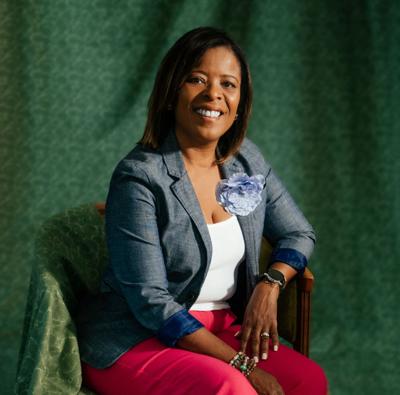

Katina Beard is a loyalist. Having been with Matthew Walker Comprehensive Health Center since 1996, she is a rare bird in a time of frequent job-hopping.
One thing that kept her on board was the organization’s mission. It has been in her heart since she learned about community health centers while studying at Tennessee State University. She graduated with an undergraduate degree in health care administration and planning and went to Meharry Medical College to earn an M.S. in public health.
“The outpatient setting really called to me, and being able to serve communities that needed health care — communities of color, poor communities,” she tells the Post.
It’s righteous work that she feels called to by God, she says.
“Me being here for 27 years is really because I just believe in the work of this organization, but I also believe in the model of community health centers very strongly,” she says. “That’s what keeps me here. It’s the people. It’s the mission. It’s the work. It’s the purpose.”
Another reason for her longevity was the opportunity to reinvent herself over and over again within the same organization. She was the center’s first operations manager at the start of her career, managing a staff of around 30 people. Then she became a liaison between staff and architects when the organization built a new building. Next she moved into grant writing and program development. In 2014, she became the CEO.
Matthew Walker’s clients are resilient in the face of adversity, so she strives to embody that quality in her leadership and instill resilience among the organization’s staff.
“We lean into hard times,” Beard says. “When the tornado came, we leaned into it. When finances got hard, we leaned into it. We’re not a skittish organization.”
She’s also not afraid to delegate and give others a chance to represent the organization. She knows many of them care about the mission just as much as she does.
“I’m not the only one that goes out now and sits in meetings and represents the organization because I know I have other people that are capable of doing that,” she says. “They are able to navigate our partnerships and our relationships and maintain the integrity of our mission and our vision.”
Health care may be a male-dominated industry, but Matthew Walker has always been led by women, she says. They outnumber the men on staff.
Beard found a mentor in former CEO Michelle B. Marrs. Noting that Beard needed more professional clothes than she could afford, Marrs brought her a bag of clothes from her own closet.
“That had to be 20 years ago,” Beard says. “I still wear some of those clothes, because she cared so much about me and my image.”
Being in a female-dominated and majority-Black workplace gives a sense of comfort, Beard says, but it’s been a journey to bring her full self to work. Only in recent years did she start braiding her hair for professional headshots. She thinks a lot of women struggle with balancing a sense of self with professionalism in the workplace.
“We’re trained to always show up with a stiff upper lip like it’s all OK,” she says. “It’s not OK some days. Stuff is down on the ground, around your feet. I’m sitting at this table trying to not bust out crying. ... I’m trying to keep it all together because if not, you’re an irrational, emotional woman, like, ‘What’s wrong with her today?’”
Beard’s directness is something she likes about herself, something that became ingrained by her upbringing in Chicago. However, she has faced backhanded compliments as a Black woman who also appears younger than her years. One common example is, “You’re so articulate,” she says.
“Being an African American leader in certain communities and at certain tables, people still wonder, how did you get here?” she told the Post. “People are amazed that we can pull together our nouns and our verbs and not be emotional and get our point across and are not looking for any type of savior. And I say that to really well-meaning white people.”
When faced with a new challenge, Beard’s daughter will pull out a common Gen Z saying, “I’m just a girl.”
“I know a lot of women who, at the height of their career, still don’t show up as a girl in the room. We show up with our suit jacket on with a lapel flower, a stiff back pulling up to the table, she says. “It’s never been a soft space.”
She’ll say to her daughter, “Well, I’m just a girl too!”


